
Home › Travel guides › Best Time to Visit Yogyakarta
Best Time to Visit Yogyakarta: Month by Month, Rainy Season, and When to Book
When is the best time to visit Yogyakarta? The honest answer is not a single month: the dry season gives you the best odds of a clear Borobudur sunrise, the rainy season gives you greener landscapes and thinner crowds — and the right choice depends on what you want to do. Here is the month-by-month picture, what the rain actually means for each activity, the Monday opening rule, and when to book.

The short answer: dry season if you can choose
If you can choose your dates, come in the dry season — generally the middle of the year. That is when you have the best odds of clear mornings, a Borobudur sunrise worth waking up at 3am for, and every activity open. But the rainy season is not the wash-out many first-timers fear: rain generally falls in the afternoon, mornings are often clear enough for the temples before noon, and the countryside is at its greenest.
The decision in one line
Choose the dry season if Jomblang Cave, a cycling day or a Borobudur sunrise is on your list. Choose the rainy season only if your dates are fixed and your plan is temples, food and workshops.
Dry season vs rainy season — what actually changes
Yogyakarta has two seasons, and they change the trip depending on what you plan to do. The temples are open in both — the difference is in the sky, the ground under your feet, and which activities are running.
In the dry season, the mornings are generally clearer and drier: sunrise is more likely to be a real sunrise than a grey dawn, and the countryside turns gold and dusty. The trade-off is that this is also when most people come, so the popular tickets sell out first.
In the rainy season, the rain generally comes in the afternoon. Mornings are often still usable — that is why we plan temple visits for the morning in any season — but an afternoon can be lost to a heavy downpour. The landscape, though, is at its best: green rice fields, full rivers, and morning mist. And there are simply fewer people at the temples.

Month by month in Yogyakarta
Read this as general guidance, not a forecast: seasons shift a little year to year, and nowadays they are harder to predict than they used to be. What follows is the pattern we plan around — in our experience, December to March is when the rain sets in.
| Months | Generally | Best for / watch out |
|---|---|---|
| December – March | The wettest months; rain on many days, usually afternoons, mornings often still clear | Temples at their quietest; Jomblang usually closed; hardest for a Borobudur sunrise; busy at Christmas and New Year |
| April – May | Shoulder season: rain eases, skies clear, crowds not yet built up | Often the sweet spot; Jomblang usually reopens, though the exact timing varies — ask us |
| June – August | The driest months; most reliable for sunrise and every outdoor activity | Busiest — school and public holidays; book at least a week ahead, earlier for sunrise |
| September – October | Dry season holds into September; rain returns gradually through October | Good weather without the peak crowds; the change of season has no fixed date |
| November | Rain returns gradually; wet afternoons, often-clear mornings | The change of season has no fixed date; Jomblang usually closed again |
For a longer stay, see our Custom Yogyakarta Package — and if you are still deciding how long to stay, our guide to how many days in Yogyakarta.
Is the rainy season worth it?
It depends on what you came for. The rainy season is worth it if your trip is built around the temples, the food and the workshops, and you let the weather set the pace of each day. It is not worth it if your trip depends on one specific outdoor moment that the rain can take away.
The best rainy-season strategy is the one we use: put the outdoors in the morning and keep the afternoons flexible. Borobudur and Prambanan in the morning, when the sky is most often clear; lunch, a workshop, or a rest in the afternoon, when the rain generally comes. A food tour, a batik or silver workshop, and the palace area all work in the rain in a way a cave or a bike ride does not.
What the rainy season cannot give you is a guarantee. A Borobudur sunrise in January may be magnificent — or a grey morning with the sun hidden behind cloud. If a sunrise is the single thing you most want, do not leave it to the rainy season. And if Jomblang Cave is the reason for your trip, the rainy season is the wrong time to come: it is usually closed.
Our honest rule for rainy-season trips
Come in the rainy season if your dates are fixed and you want Yogyakarta itself — the temples, the food, the crafts, the green landscape — with fewer people around. Do not come for one specific outdoor moment, and do not build a day around Jomblang or a cycling route. Tell us your dates, and we will tell you honestly what the season allows.
How timing affects each activity
Season is not one decision for the whole trip — it is a separate answer for each thing you want to do.
Borobudur sunrise. The sunrise ticket is limited to 100 people a day in any season, and it is the ticket most affected by the weather: a cloudy morning means no sunrise at all. In the dry season your odds are best; in the rainy season they are lower — so book at least a week ahead either way, and earlier in high season. If the sunrise ticket is sold out, Setumbu Hill is a cheaper viewpoint alternative: leave Yogyakarta at 3:00–3:30 AM, be there by 4:30 AM at the latest, and pair it with the first Borobudur climb session at 8:30. For the full booking picture, see our guide to how to book Borobudur tickets.
Borobudur regular climb. The climb runs all year, in timed sessions, with the climb quota often quoted as around 1,200 people a day — a quota that can be raised in high season. The morning climb sessions, sessions 1 and 2, sell out fastest, so an early-morning climb needs booking well in advance in any season. The climb now opens on Mondays too (see below).
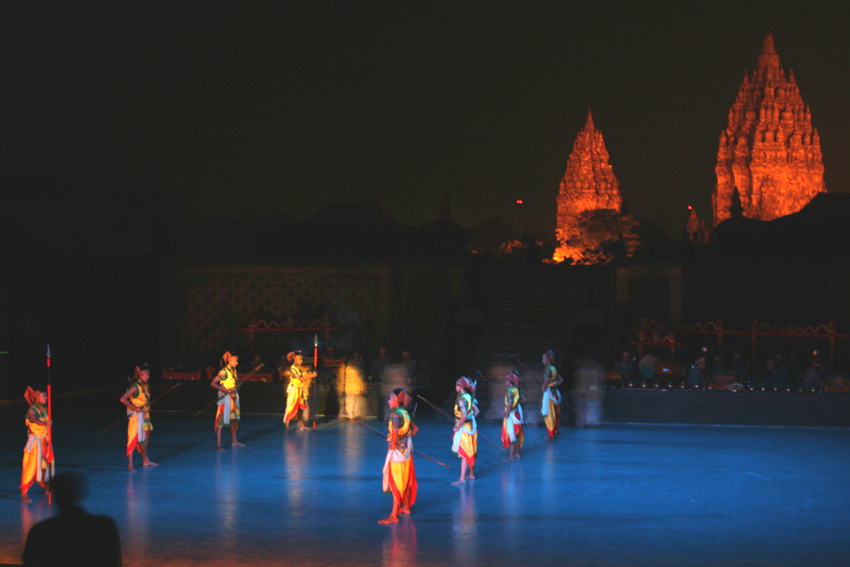
Prambanan and the Ramayana Ballet. Prambanan works in both seasons — the late-afternoon light is the point, and the sun sets at around 5:30–6pm for most of the year. The Ramayana Ballet runs on Tuesday, Thursday and Saturday evenings (7:30–9:00pm): open-air in the dry season, and indoors when it rains — which in practice means often during the rainy season. We cannot say in advance which nights will be indoors; it depends on the weather. If it rains before the show starts, the performance moves indoors to the Trimurti Theatre; if rain comes after 45 minutes, the show counts as finished and there is no refund.
There are two Ramayana stages, and their schedules complement each other: the ballet plays at Prambanan on Tuesday, Thursday and Saturday evenings, and at Purawisata — an indoor amphitheatre in the city, near Malioboro — on Monday, Wednesday, Friday and Saturday evenings (7:30–9:00pm). So there is a performance somewhere every night of the week; on Sundays, Purawisata stages the traditional Roro Jonggrang performance instead. Friday at Prambanan is also a Roro Jonggrang night, indoors at the Trimurti Stage (7:30–8:30pm), not the Ramayana Ballet.
At Prambanan, tickets come in four classes — VIP, Special, Class I and Class II. At the open-air theatre, VIP and Special seats are numbered (VIP also includes a soft drink and traditional snacks); Class I and II are unnumbered. Indoors at the Trimurti Stage there is only the Special class, numbered, with live gamelan music. Plan your Prambanan evening for one of those nights if the ballet is on your list.
Jomblang Cave. This is the activity most ruled by the season: Jomblang Cave is usually closed in the rainy season, full stop. It also needs booking at least two days ahead and prime physical fitness in any season. If Jomblang is on your list, come in the dry season — and read our Jomblang Cave preparation guide before you decide.
Cycling. Cycling is not recommended in the rainy season: village roads get muddy and slippery, and a bike ride in a downpour is no fun at all. In the dry season it is one of the best ways to see the countryside around Borobudur, Prambanan and the villages — helmet, water and a snack included, with a passenger seat available.
Food tours and workshops. The morning and evening food tours run in both seasons — whether we go out in the rain is the guest's call — and a workshop — batik, silver, wayang or pottery — is the perfect rainy-afternoon activity: indoors, unhurried, and you take home what you make.
Crowds, high season, and when to book
The best month for weather and the best month for crowds are not the same month. The driest months are also the busiest, and that changes how far ahead you need to book.
Book at least a week ahead, especially in high season, and never leave it close to the day. That matters most for the sunrise — limited to 100 people a day — and for the morning climb sessions, sessions 1 and 2, which sell out fastest. Weekends and public holidays go fastest too. If your dates are fixed, book as soon as you know them.
High season depends on who is travelling. For European guests it is the summer, June to August. For Southeast Asian guests it is usually January to March. And on the local calendar, Christmas and New Year and the Eid (Lebaran) holidays are high season, when domestic travellers join international visitors at the temples. In high season the climb quota can be raised and Mondays can open, but tickets still sell out faster and the temples are fuller. The shoulder months are the compromise: generally good weather with thinner crowds and slower-selling tickets.
One more thing the season changes: the light. The sun sets at around 5:30–6pm for most of the year, so the golden hour at Prambanan is a reliable plan in any month — as long as you are inside before ticket sales close at 4pm. For the one-day temple plan, see our guide to Borobudur and Prambanan in one day.
The Monday rule — plan around it
There is one day-of-the-week trap that catches more visitors than the weather does: Monday. The old rule — Monday as the weekly closing day for Yogyakarta's historical sites — no longer holds for Borobudur: Borobudur now opens on Mondays, including the climb, and the plan is for Mondays to stay open. Prambanan is different: on Mondays you can enter the complex, but only the outer area — the temple area itself stays closed.
So a Monday is no longer automatically a lost day for Borobudur — but it is still a limited day for Prambanan, and Monday hours can change. Check the official ticket site, or ask your tour operator, before you lock in a Monday visit. And if your trip is short, do not put your one Prambanan visit on a Monday — the temple area will be closed. Monday works for Borobudur, the food tour, a workshop, or the city.
Which month should you pick?
It comes down to what matters most to you. There is no wrong month — only a month that fits your trip, and one that fights it.
Go in the dry season if…
- A Borobudur sunrise is the highlight of your trip
- Jomblang Cave or a cycling day is on your list
- You want every activity open and the best odds of clear mornings
- You can book at least a week ahead — and earlier for a sunrise
Go in the rainy season if…
- Your dates are fixed and your plan is temples, food and workshops
- You like green landscapes, morning mist and thinner crowds
- You are happy to put the outdoors in the morning and keep afternoons flexible
- Jomblang and cycling are not on your list
And if you can choose freely, consider the shoulder months — generally good weather with fewer people than the peak, and tickets that sell more slowly.
Quick questions
If you can choose, the dry season — generally the middle of the year — gives you the best odds of clear mornings and a Borobudur sunrise. But the rainy season is not a write-off: mornings are often clear enough for the temples before noon, crowds are thinner, and the countryside is at its greenest. The honest answer depends on what you want to do: Jomblang Cave is usually closed in the rainy season, and cycling is not recommended in the rain.
Yes — with the right expectations. Rain in Yogyakarta generally falls in the afternoon, and mornings are often clear enough for Borobudur and Prambanan before noon. The trade-off is real, though: Jomblang Cave is usually closed in the rainy season, cycling is not recommended in the rain, and a sunrise can be clouded out. If you come in the rainy season, plan the temples for the morning.
Sometimes — but the odds are lower than in the dry season. The sunrise ticket is limited to 100 people a day in any season, so book at least a week ahead, especially in high season. If the sunrise ticket is sold out, Setumbu Hill is a cheaper viewpoint alternative: leave Yogyakarta at 3:00–3:30 AM, be there by 4:30 AM at the latest, and pair it with the first Borobudur climb session at 8:30.
Usually not — Jomblang Cave is usually closed in the rainy season, and it is the one activity that genuinely depends on the season. It also needs booking at least two days ahead and prime physical fitness in any season. If Jomblang is the reason for your trip, come in the dry season.
No — not anymore. Borobudur now opens on Mondays, including the climb, and the plan is for Mondays to stay open. Prambanan is different: on Mondays you can enter the complex but only the outer area, not the temple area. Monday hours can change, so check the official ticket site, or ask your tour operator, before you lock in a Monday visit.
Book at least a week ahead, especially in high season, and never leave it close to the day. The Borobudur sunrise and the morning climb sessions (sessions 1 and 2) sell out fastest, and weekends and public holidays go fastest too. If your dates are fixed, book as soon as you know them.
Please note: month-by-month weather is general guidance, not a forecast — seasons shift year to year. Ticket types, quotas, session rules and opening hours can also change. Before you travel, check the latest details on the official ticket site: ticket.injourneydestination.id/en.
Ready to pick your dates?
Our Custom Yogyakarta Package is built around your dates, your group size, and the season you are travelling in — temples in the morning, food, workshops and the coast around them, with a private car and an English-speaking driver. Tell us your dates and what matters most to you, and we will tell you honestly what the season allows, and confirm price and availability.